
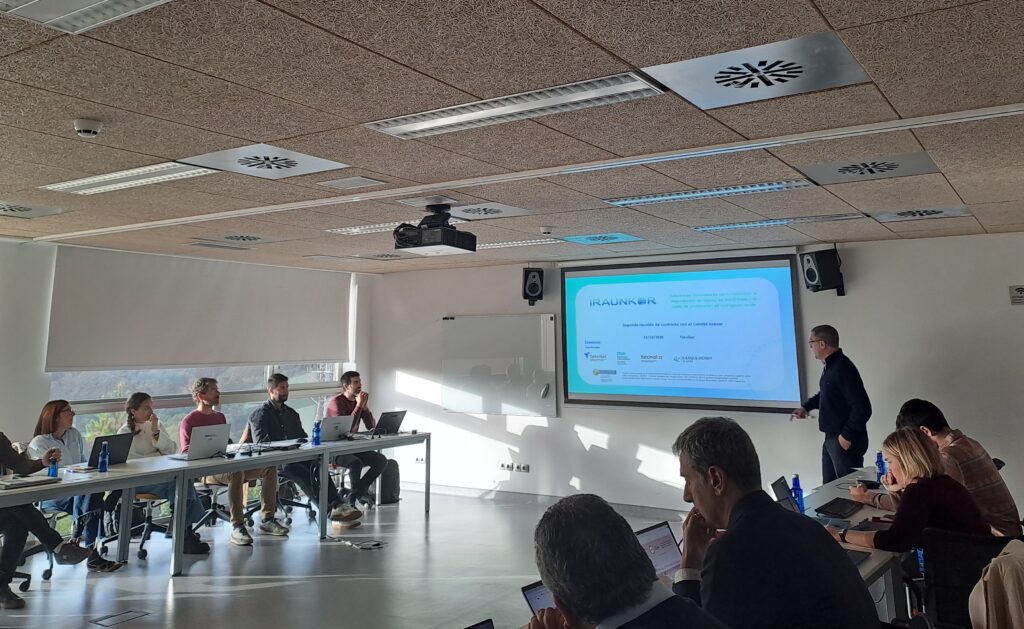
The event, organised by BASQUENERGY Cluster in collaboration with TEKNIKER, TECNALIA and MONDRAGON UNIBERTSITATEA, brought together representatives from BOSLAN, INGETEAM, NORDEX ELECTROLYZERS, PETRONOR, SAITEC, SENER and TSK to present the experimental campaigns and degradation models developed under the Elkartek project.
The IRAUNKOR review meeting, held on 23 October at Tekniker’s facilities in Eibar, served as a meeting point between the consortium and its Advisory Committee, with the aim of presenting the work carried out during the first year of project implementation. During the session, attendees took part in a Q&A round to address questions and share their views on the progress achieved.
IRAUNKOR has an Advisory Committee made up of key companies in the green hydrogen sector in the Basque Country, including manufacturers, engineering firms and operators. As the project’s consultative body, its role is essential in providing strategic guidance and technical advice to the consortium. Its involvement is key to ensuring the transferability of the results to the Basque industrial fabric.
The event began with a welcome and introduction by Lucia Mendizabal, IRAUNKOR coordinator and researcher at Tekniker, and Marcos Suárez, representative of BASQUENERGY Cluster.
Next, Jon Aizpuru, from Mondragon Unibertsitatea, presented the Dynamism Metric, developed to characterise the variability of input signals in the electrolyser. This tool makes it possible to analyse bibliographic data, standardise tests and design the experimental campaigns for the different technologies covered by the project: PEM, AEM and alkaline.
Subsequently, Ángela Barros, from Tekniker; Naroa Almenara, from Tecnalia; and Jon Aizpuru shared the results obtained from the experimental tests carried out by the three technology centres to study stack degradation. The analysis is conducted using polarisation curves, in-operando electrochemical impedance spectroscopy (EIS), and post mortem characterisation of the stacks.
After the coffee break, Irati Echarri, from Tekniker, and Iñaki Madinabeitia, from Tecnalia, presented to the Advisory Committee the mathematical models that represent degradation mechanisms as a function of time and the stacks’ operating mode. Once these models have been implemented in operational strategies aimed at mitigating degradation, they will be validated experimentally.
Finally, researcher Ane Elizetxea, from Mondragon Unibertsitatea, presented the progress made in the numerical assessment of the impact of the new strategies on stack degradation, examining different energy sources and the integration of batteries into the system. In addition, a techno-economic analysis of the strategies developed in IRAUNKOR was presented, assessing key indicators such as energy efficiency, service life and the levelised cost of hydrogen (LCOH).
The project will conclude in March 2027, with the organisation of an open transfer workshop at which the results of the research project will be presented to the business sector.