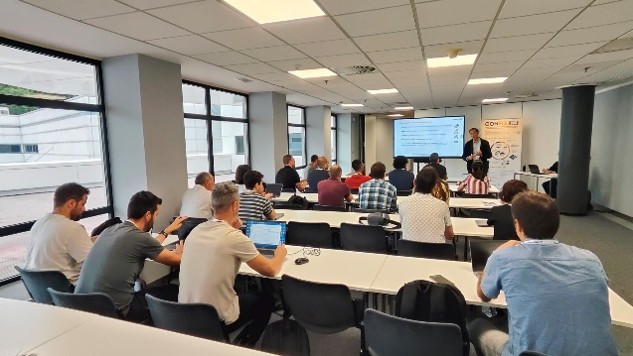
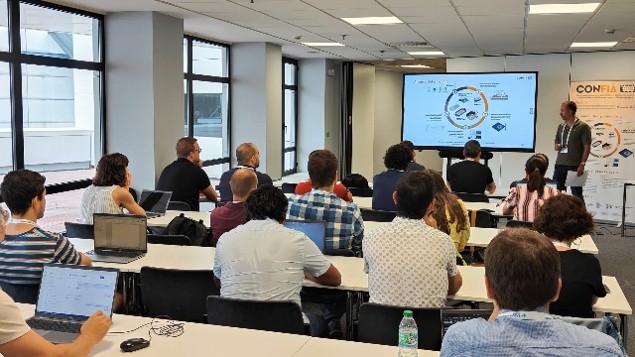
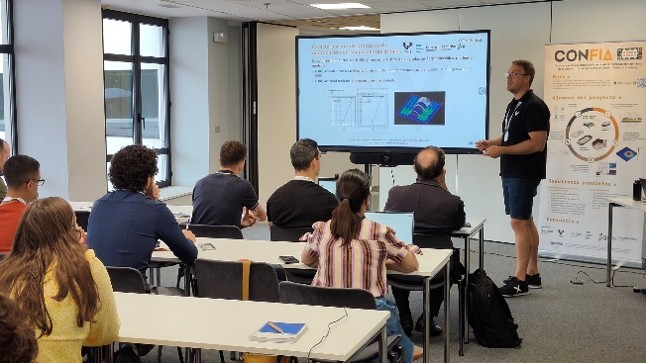
The session, organized in collaboration with Tecnalia, EHU, Ikerlan, Mondragon Goi Eskola Politeknikoa, and Zigor R&D, brought together 11 representatives from 9 organizations, who learned firsthand about the research progress of the Elkartek project and discussed technologies to estimate and predict degradation states, as well as increase the reliability of the most critical components in power electronics converters: silicon IGBT semiconductors and capacitors.
The CONFIA technology transfer workshop, which took place on July 3 at the Bizkaia Technology Park (Zamudio), is part of the communication, dissemination, and results transfer activities that BASQUENERGY Cluster coordinates within the project. The meeting aimed to inform participants about research advances and project progress, gather feedback from companies in the energy sector, and promote opportunities for collaboration and technology transfer.
In the session, moderated by BASQUENERGY Cluster, the project’s technological partners—Tecnalia as coordinator, together with the Department of Electronic Technology at EHU (through the Vitoria-Gasteiz section and APERT—Applied Electronic Research Team), Ikerlan, Mondragon Goi Eskola Politeknikoa (MU-EPS), and Zigor R&D—presented the research work carried out and its preliminary results in the various work areas.
The CONFIA project is advancing research into technological solutions to estimate degradation and increase the reliability of the most critical components in power electronics converters with high implementation in the energy sector: silicon IGBT module semiconductors (Insulated Gate Bipolar Transistors) and capacitors.
To characterize the physical mechanisms of degradation, behavioral and switching models, advanced electrophysical modeling tools, and a system relating stressors, failure mechanisms, and measurable precursors have been used. Experimental characterization is being addressed through the development of two laboratory test benches: an automatic cycling platform for industrial Easy IGBT format modules (silicon compatible) and an Alternating Current (AC) cycling platform for 62mm silicon IGBT modules. Furthermore, synthetic data has been generated using public datasets and electrothermal simulations.
In parallel, three non-intrusive systems for measuring the junction temperature of IGBTs have been designed: the first is based on an online collector-emitter voltage measurement method through automatic desaturation of a signal MOSFET; the second method detects the gate peak current and its correspondence with the variation in internal gate resistance; and the last one is based on the injection of a high-frequency signal to measure internal gate resistance.
The synthetic data generated through thermoelectric simulations, along with public datasets, are being labeled to determine degradation patterns of the IGBT packaging. Based on these, the development of unsupervised algorithms is planned, in addition to proposing supervised Machine Learning techniques to automatically distinguish between bond-wire degradation and solder degradation separately.
Regarding degradation control and modulation algorithms, thermal management techniques are being studied through the dynamic regulation of the switching frequency on a simulation platform. Simultaneously, low switching frequency modulations have been analyzed, proposing additional regulation loops to act directly on the temperature of the IGBTs when frequency reduction is not sufficient. Finally, a specific line dedicated to improving the reliability of the DC bus has been developed.
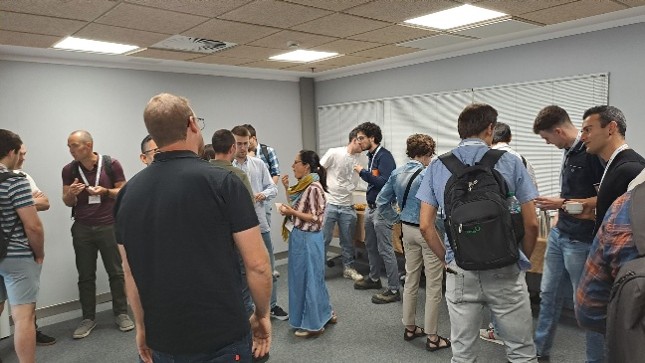
Throughout the session, spaces for dialogue were opened where attendees could share their impressions and assessments of the presentations. Additionally, the applicability of current research to the companies’ business areas was analyzed, and technological needs were identified that could lead to future R proposals, ranging from fundamental research to industrial development driven directly by the business community.
Looking ahead to the last quarter of 2026, coinciding with the project’s closing phase, BASQUENERGY Cluster will coordinate a second technology transfer workshop. In this meeting, the partners will present the final conclusions and results of their research in order to continue consolidating new opportunities for joint collaboration.
ABOUT CONFIA
 CONFIA—Advanced techniques for estimating degradation and increasing the reliability of components in power converters—is a project coordinated by Tecnalia in collaboration with EHU (through the Vitoria-Gasteiz section and APERT—Applied Electronic Research Team), Ikerlan, Mondragon Goi Eskola Politeknikoa (MU-EPS), Zigor RD, and BASQUENERGY Cluster. It has a duration of 2 years and is subsidized by the Department of Industry, Energy Transition, and Sustainability of the Basque Government through the ELKARTEK 2025 program.