
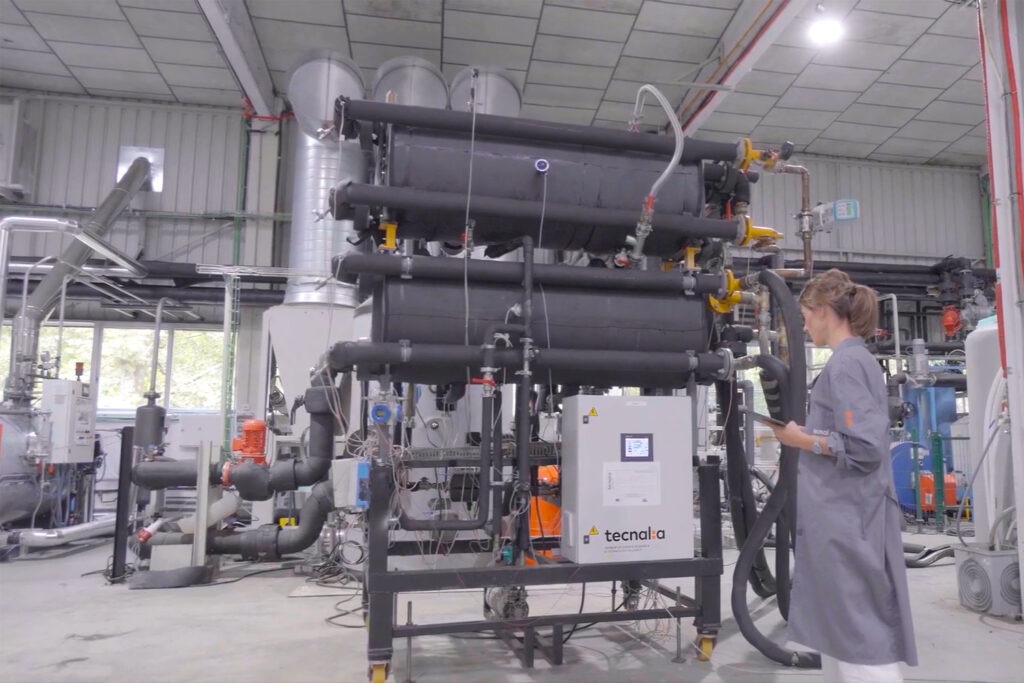
The research centre has launched the startup Revalheat, focused on developing solutions to recover and upgrade low-temperature industrial waste heat that is currently wasted. The Absorption Heat Transformer developed by Revalheat recovers waste heat at inlet temperatures between 70 and 110°C and increases its temperature up to 120–150°C to meet thermal demands within the industrial process itself or associated with low-pressure steam requirements. The scalable design of the technology allows solutions to be developed from approximately 200 kW in capacity up to larger industrial-scale projects.
TECNALIA launches Revalheat, a startup capable of recovering currently wasted heat for production processes, reducing fossil fuel consumption and CO₂ emissions.
Revalheat addresses a specific challenge: the recovery and utilization of low-temperature waste heat. The company was founded with the aim of converting this waste heat into useful energy for industrial processes themselves, helping to increase facility energy efficiency, reduce dependence on fossil fuels, and advance the decarbonization of energy-intensive sectors.
The new startup is based on the Absorption Heat Transformer, known as AHT. This thermodynamic technology uses waste heat as its primary energy source, raises its thermal level, and allows it to be reintegrated into the production process under usable temperature conditions. In this way, Revalheat transforms a resource that is currently lost into an energetic and economic asset for the industry.
The Absorption Heat Transformer developed by Revalheat recovers this waste heat at inlet temperatures between 70 and 110°C and raises its temperature to 120–150°C to meet thermal demands of the industrial process itself or those associated with low-pressure steam requirements. This recovery reduces the amount of external energy required and, consequently, decreases fossil fuel consumption and CO₂ emissions.
The technology is based on an absorption cycle that uses water and lithium bromide as working fluids. The system consumes very little electricity to raise the temperature, as its main source is the waste thermal energy already available at the facility, together with the exothermic process inherent to absorption. With a thermal coefficient of performance (COP) of approximately 0.5, the device upgrades around half of the input waste heat, raising its temperature by 30–50 K without the need for additional energy.
Revalheat also works on the optimization of control systems, both in the operation of the transformer itself and in its integration with production processes. This control is essential for adapting the equipment’s response to the operational and energy variations of each industrial facility.
The technology’s scalable design allows for the development of solutions ranging from approximately 200 kW in capacity to larger-scale industrial projects.
Its viability has already been demonstrated in real industrial environments within the framework of various European projects, which have shown improvements in energy efficiency, emissions reduction, and savings in operating costs, with return-on-investment periods of 2 to 4 years. This allows industrial companies to get ahead of new regulatory requirements, reduce the climate impact of their processes, and improve the environmental performance of their facilities without sacrificing operational efficiency.
With this launch, TECNALIA is promoting a new solution aimed at solving one of the industry’s main energy challenges: harnessing low-temperature waste heat and reducing the amount of external energy required to maintain production processes. REVALHEAT aims to conduct the techno-economic study, manufacturing, and installation of absorption heat transformers.
Original source: Tecnalia