
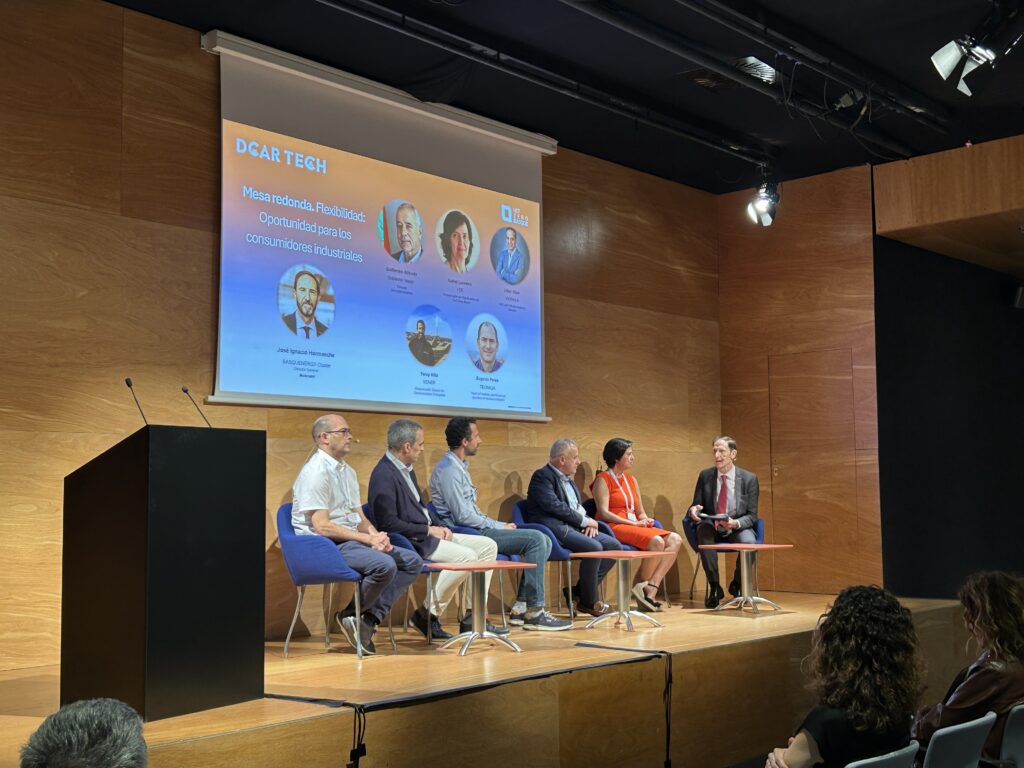
On 26 May, the BEC hosted a new meeting of the Industry Decarbonisation Forum, coordinated by SPRI and organised by the DCARTECH alliance, comprising BASQUENERGY Cluster, ACLIMA, AFV, CLUSTERPAPEL, SIDEREX, ACICAE, and HEGAN. The event brought together more than 100 institutional, industrial, technological, and energy stakeholders to address industrial electrification, the role of the electricity grid, demand flexibility, and emerging electrification technologies.
The day began with the intervention of Cristina Oyón, Deputy Director General of SPRI, who presented the progress and status of the Net-Zero Basque Industrial SuperCluster (NZBISC) initiative, promoted by the Basque Government and SPRI with the dual objective of accelerating the decarbonisation of energy consumption in Basque industry, through solutions that reduce its net emissions, and generating opportunities for technological developments in Euskadi. During her presentation, she reviewed the work currently underway within the framework of the initiative and presented the results of the industrial decarbonisation projects submitted to the ELKARTEK and HAZITEK 2026 calls.
The first technical block continued with the intervention of Isabel Loureiro, Head of North Zone Grid Planning at i-DE, who presented the paper “Electricity grid for Basque industry: flexibility and reinforcement investments”. Her presentation addressed the role of the electricity grid in the electrification process of Basque industry, focusing on the need to combine reinforcement investments with new flexibility mechanisms to more efficiently integrate the growth in electricity demand. The presentation contextualised the main challenges associated with the connection of new industrial consumption, grid planning, and the search for solutions to optimise its use.
Within this framework, Luis Layo, Head of Innovation at i-DE, presented the DEMELEK project, focused on the development of prospective models and new flexibility services to boost demand electrification. The project seeks to provide tools to anticipate future electricity consumption scenarios, identify grid capacity needs, and design flexibility mechanisms aimed at facilitating the incorporation of new industrial consumption more efficiently.
Following these interventions, the round table “Flexibility: an opportunity for industrial consumers” was held, moderated by José Ignacio Hormaeche, Managing Director of BASQUENERGY Cluster. Participants included Isabel Loureiro, Head of North Zone Grid Planning at i-DE; Guillermo Allende, Director of Decarbonisation of the Basque Government; Liher Irizar, R&D and Vidrala Academy Director at Vidrala; Yeray Villa, Technical Manager of Energy Manageability at Sener; and Eugenio Perea, Head of Flexibility and Advanced Operation of Electrical Networks at Tecnalia. The debate addressed flexibility from different perspectives—institutional, energy, industrial, and technological—analysing the opportunities it can offer industrial consumers, as well as the regulatory, technical, and economic conditions necessary for its deployment.
After the coffee break, the second block of the day focused on technologies and solutions for the electrification of industrial processes. Nora Fernández, Project Director in the Energy Transition Unit at TECNALIA, presented the report prepared within the framework of NZBISC on the potential of emerging electrification technologies. The presentation analysed technology alternatives with different degrees of maturity and assessed their possible application in processes where the replacement of fossil fuels with electrical solutions can contribute to improving efficiency and reducing the environmental impact of industrial activity.
Subsequently, Mikel San Julián, Head of Strategic Consulting at IDOM, and Juan Carlos Sanz, Green Hydrogen & Biogas Coordinator at IDOM, presented the paper “Electrification of industry: context and case studies”. The intervention focused on specific applications and the main technical and economic factors to be considered when proposing this type of action. In this way, it helped bring industrial electrification closer to real cases, showing both the existing opportunities and the challenges associated with their implementation in production environments.
Next, a block of pitch-type presentations was held by companies offering decarbonisation solutions and services. In this space, María Benito, Founding Partner and CEO of MARGUBE; Iñigo Arrizabalaga, Director of TELUR; and Sandra Seijo, Head of AI in the Innovation Area of AYESA Digital, presented their capabilities and proposals in areas related to energy efficiency and the CAE system, electrification, process optimisation, artificial intelligence, and the development of solutions aimed at reducing industry emissions.
The session concluded with the intervention of Adriana Martínez, DS Industry Event Manager at BEC, who presented the Decarbonized & Sustainable Industry fair, to be held from 3 to 5 November 2026 at the BEC. The event was presented as an opportunity to continue strengthening Euskadi’s positioning in the field of industrial decarbonisation, connecting technological supply and demand and facilitating new spaces for collaboration between companies, technology centres, public administrations, and sectoral agents.