
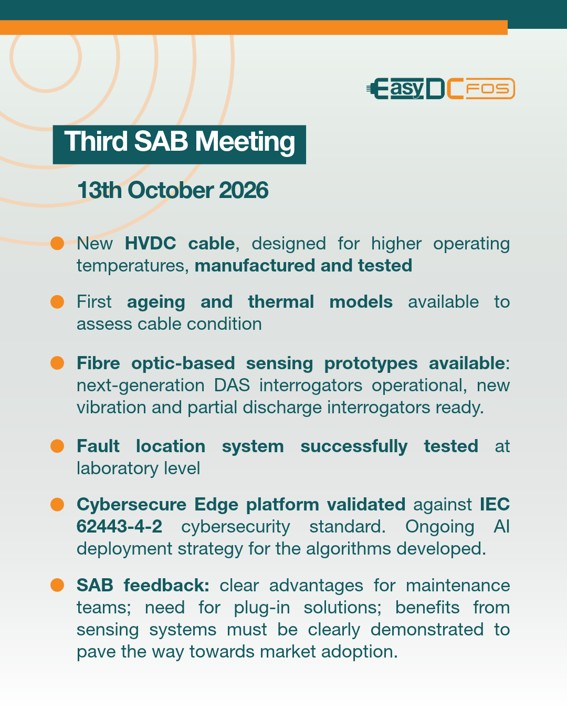
The meeting brought together project partners, system operators and technology developers to review the progress and results achieved in recent months and to gather the Advisory Committee’s assessments and recommendations ahead of the project’s final year, in which validation and demonstration activities will be addressed.
On 13 October, a new meeting of the Advisory Committee of the European EasyDC-FOS project was held, organised and moderated by BASQUENERGY Cluster in collaboration with the consortium partners, with the participation of representatives from Red Eléctrica, TenneT, Amprion, EDP Redes España and DOFI (Danish Optical Fiber Innovation).
During the session, progress on the technical tasks over recent months was reviewed. The new HVDC cable, designed to operate at higher temperatures than current solutions, has successfully completed its manufacturing process. In addition, its testing programme has been carried out and the first thermal and ageing models are now available.
With regard to sensorisation and monitoring, the next-generation DAS (Distributed Acoustic Sensing) interrogator prototypes are already operational, and the new versions of the interrogators for vibration and partial discharge detection have been completed. The fault location system, which combines both technologies, has been successfully tested at laboratory level.
In parallel, a cybersecurity framework aligned with the main European and international regulations and standards has been defined, together with a comprehensive risk assessment. The Edge platform that processes the sensor data has been validated in accordance with the IEC 62443-4-2 cybersecurity standard, and an edge deployment strategy has been established for each algorithm, supported by illustrative dashboards.
During the meeting, Manuel Muñoz (SterlumiQ), the project coordinator, highlighted the growing strategic role of the electricity transmission grid and the need for direct-current networks for long-distance transmission, as well as digital sensorisation and monitoring solutions.
The members of the Advisory Committee acknowledged the progress achieved and the usefulness of these systems for transmission network maintenance, as they could anticipate incidents and provide greater insight into the health status of the cables. Cybersecurity attracted particular interest, and the Committee members underlined the importance of having easy-to-integrate solutions (plug-in), as well as demonstrating the benefits of sensorisation systems as a first step towards their adoption.
In the coming months, a new meeting will be held with the Advisory Committee to report on the progress of the integration and validation activities.
The European EasyDC-FOS project
In a context marked by the urgent need to modernise electrical infrastructure to meet growing energy demand, integrate larger volumes of renewable energy and reduce external dependence, high-voltage direct-current (HVDC) transmission is positioned as a strategic solution to strengthen the European power grid.
In this scenario, the European EasyDC-FOS project seeks to develop a new generation of 525 kV HVDC cable systems>, with optimised power transmission capacity and a lower environmental impact, combined with smart fibre-optic-based systems for ageing monitoring and efficient fault detection, integrated into a cybersecure digital environment.
Two member companies are participating in the project: RDT LUMIKER (coordinator), a company specialising in advanced monitoring systems, and Barbara, responsible for developing the cybersecure Edge computing platform. BASQUENERGY Cluster, for its part, coordinates the communication, dissemination and exploitation activities. The consortium is completed by 10 other organisations from 4 European countries, which will collaborate closely over 3 years (2024–2027): AMPACIMON, AP SENSING, ENERGINET, GREENDELTA, NEXANS, RDT, STATNETT, UNIVERSITY OF CANTABRIA, UNIVERSITY OF VALLADOLID and ZABALA.
For more information:
Website: EasyDC-FOS EU Project website
LinkedIn profile: EasyDC-FOS EU Project
Project newsletter subscription: Subscription to newsletter
 Project funded by the European Union under grant agreement No 101172806. The views and opinions expressed are those of the author(s) only and do not necessarily reflect those of the European Union or the European Commission. Neither the European Union nor the granting authority can be held responsible for them.